The short answer
Is Google Ads or Meta Ads better for B2B businesses?
Google Ads is often useful for capturing demand from people actively searching for a solution, while Meta Ads can help build awareness and reach relevant audiences earlier in the buying journey. The better option depends on your goals, audience, and industry.
Choosing the right advertising platform can significantly influence how effectively a business generates leads and uses its marketing budget. For B2B companies, the decision is particularly important because reaching the right decision-makers is only one part of the process. Turning their interest into qualified enquiries and, eventually, paying customers requires a more considered approach.
Two platforms businesses commonly evaluate are Google Ads and Meta Ads. Both offer ways to reach potential customers, but they approach audience targeting differently. Google Ads can connect businesses with people actively searching for relevant solutions, while Meta Ads can introduce offers to audiences based on their interests, characteristics, and behaviour.
So, when comparing Google Ads vs Meta Ads, which platform delivers better return on investment (ROI) for B2B businesses? This blog will give you the answer.
Understanding Google Ads and Meta Ads for B2B Marketing
Before comparing performance, it is important to understand how each platform reaches potential buyers.
How Google Ads Works for B2B
Google Ads allows businesses to display advertisements across Google Search and other advertising placements. Search campaigns are particularly useful when potential customers are actively looking for a service, product, or solution.
Google Ads for B2B can be useful for targeting specific search terms, capturing existing demand, and attracting visitors who are actively researching solutions.
However, results depend on keyword selection, competition, ad relevance, landing page quality, and how well your offering matches the searcher’s intent.
How Meta Ads Works for B2B
Meta Ads enables businesses to advertise across platforms such as Facebook and Instagram. Instead of relying primarily on active search queries, campaigns can reach audiences based on available targeting options, interests, behaviours, and engagement with a business.
Meta Ads can also support B2B Lead Generation, retargeting, allowing businesses to reconnect with eligible audiences who have previously interacted with their website or content, subject to applicable tracking and privacy requirements.
Google Ads vs Meta Ads: Key Differences
Although both platforms support paid advertising, their strengths differ. Here is a detailed analysis of Google Ads vs Facebook Ads:
| Factor | Google Ads | Meta Ads |
|---|---|---|
| Primary approach | Captures existing search demand through search campaigns | Creates awareness and reaches audiences based on targeting signals |
| Audience intent | Often stronger when users actively search for a solution | Often useful for reaching potential buyers before they begin searching |
| Targeting | Keywords, location, audiences, and other campaign settings | Audience characteristics, interests, behaviours, and engagement options |
| Common B2B uses | Service enquiries, high-intent leads, and demand capture | Awareness, lead generation, content promotion, and retargeting |
| Competition | Costs can be high for competitive commercial keywords | Costs depend on audience, competition, creative, and campaign objectives |
| Creative requirements | Search ads rely heavily on relevant messaging and search intent | Visuals, videos, and creative messaging can play a larger role |
| Measurement | Clicks, conversions, leads, and attributed revenue | Clicks, conversions, leads, and attributed revenue |
These are general differences rather than fixed rules. Both platforms offer multiple campaign formats, and actual results depend on how campaigns are configured and managed.
Comparing Google Ads and Meta Ads for B2B ROI
B2B purchases often involve multiple decision-makers, longer evaluation periods, and significant differences in customer value.
Cost Per Click (CPC) and Cost Per Lead (CPL)
Cost per click measures how much you pay for each advertising click, while cost per lead measures the average advertising cost of generating a lead.
Google Search campaigns targeting high-intent commercial keywords can face substantial competition, particularly in industries where each customer is valuable.
Meta Ads may generate less expensive clicks or enquiries in some campaigns, but lower costs do not automatically translate into better business results.
Lead Quality and Conversion Rates
Lead quality is particularly important in B2B marketing because sales teams may spend considerable time evaluating and nurturing each enquiry.
Search campaigns can capture prospects who are actively looking for a solution, making them valuable when search intent aligns with your offering.
Meta campaigns can reach people who fit your target audience but may not be ready to buy immediately. These prospects might require additional information, follow-up, or nurturing before they become sales opportunities.
Audience Targeting Capabilities
Google Ads is particularly useful when your audience can be identified through relevant search behaviour. Keywords help connect your business with people expressing an immediate need.
Meta Ads offers different targeting opportunities, allowing businesses to reach relevant audiences through available audience characteristics, interests, engagement, and remarketing options.
Sales Cycle and Conversion Tracking
B2B sales cycles can extend over weeks or months, especially when purchases involve multiple stakeholders, budgets, or approvals.
A campaign might generate a lead today, but the eventual sale may happen much later. Measuring only immediate conversions can therefore give an incomplete picture of performance.
Set up conversion tracking for meaningful actions, such as qualified enquiries, booked meetings, sales opportunities, and completed purchases where applicable.
When Should B2B Businesses Choose Google Ads?
Google Ads is often a strong starting point when potential customers actively search for the products or services you provide.
Consider it when:
- Your business offers solutions people already search for online.
- You want to capture demand from prospects with a clear requirement.
- Your services address specific commercial problems.
- You can identify relevant keywords and build focused landing pages.
- Your business can compete effectively for valuable search terms.
Before investing, assess search demand, keyword competition, expected costs, and the commercial value of a converted customer.
When Should B2B Businesses Choose Meta Ads?
Meta Ads can be useful when your business needs to build awareness, reach potential buyers who are not actively searching, or promote content that introduces a problem and its solution.
Consider it when:
- Your service benefits from visual explanation or demonstration.
- You want to promote industry insights, webinars, guides, or case studies.
- Your audience can be reached through relevant targeting options.
- You want to reconnect with eligible previous website visitors or engaged audiences.
- You need to support awareness before prospects enter an active buying process.
Meta campaigns require compelling creative, relevant offers, and a clear follow-up process. Generating attention is useful only when that attention can be converted into meaningful business opportunities.
Can Google Ads and Meta Ads Work Together for Better ROI?
Yes. In many cases, combining the two platforms can create a more complete advertising approach.
Google Ads can help capture existing demand, while Meta Ads can support awareness, content distribution, and retargeting. Together, they can help businesses connect with prospects at different stages of the buying journey.
Businesses should also account for overlapping audiences and attribution limitations to avoid overestimating the contribution of individual campaigns.
How to Measure ROI From Your B2B Advertising Campaigns
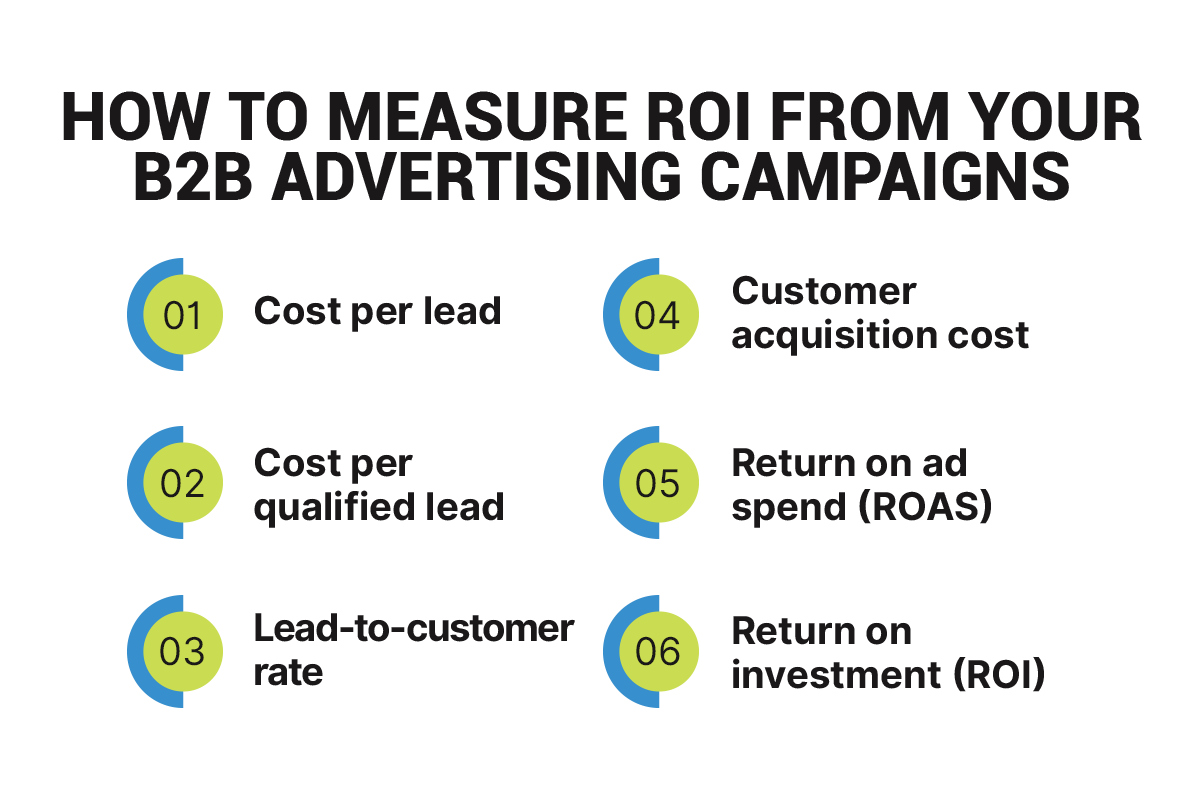
A reliable measurement framework helps you understand whether advertising is contributing to business growth.
Start by defining what you want each campaign to achieve. Depending on your business, this could mean qualified leads, booked meetings, sales opportunities, or revenue.
Next, track the metrics that connect advertising activity to those outcomes:
- Cost per lead: The advertising cost associated with generating each lead.
- Cost per qualified lead: The cost of acquiring a lead that meets your qualification criteria.
- Lead-to-customer rate: The percentage of leads that eventually become customers.
- Customer acquisition cost: The total relevant sales and marketing cost of acquiring a customer.
- Return on ad spend (ROAS): Revenue attributed to advertising divided by advertising spend.
- Return on investment (ROI): The financial return relative to the investment, calculated using an appropriate cost and profit definition.
For example, if a campaign spends $5,000 and generates $20,000 in attributed revenue, its ROAS is 4x. This does not automatically mean the campaign delivered a 300% profit ROI because operating costs, service delivery expenses, and other relevant costs still need to be considered.
Landing page optimization can be especially valuable when advertisements attract relevant visitors, but the website fails to generate enough enquiries.
Maximize Your B2B Advertising ROI With DigiClicks
Choosing the right platform is only one part of building a successful advertising campaign. Results also depend on your positioning, creative assets, targeting, landing pages, tracking, and sales follow-up.
At DigiClicks, we help businesses connect advertising with broader growth objectives through campaign strategy, Performance Marketing Services, SEO, website development services, creative design, social media management, and AI solutions.
As a digital marketing agency, we focus on understanding business goals before recommending channels and campaign approaches. This helps ensure that advertising decisions are guided by audience needs, available resources, and measurable outcomes rather than platform popularity alone.
Our approach also considers the complete customer journey, from the first advertisement to the website experience and the enquiry or purchase that follows.
The End Note
Google Ads can be particularly effective when potential customers are actively searching for a solution. Meta Ads can help businesses build awareness, reach relevant audiences, and nurture interest before a prospect is ready to buy.
Rather than focusing exclusively on clicks or cost per lead, evaluate lead quality, customer acquisition costs, and the revenue generated over time.
With clear objectives, reliable tracking, relevant messaging, and continuous optimization, businesses can make more informed advertising decisions and build campaigns that support sustainable growth.
Questions people ask
Is Google Ads or Meta Ads better for B2B businesses?
Google Ads is often useful for capturing demand from people actively searching for a solution, while Meta Ads can help build awareness and reach relevant audiences earlier in the buying journey. The better option depends on your goals, audience, and industry.
Are Google Ads more expensive than Meta Ads?
Costs vary by industry, competition, audience, campaign objective, and targeting. Google Search clicks can be expensive for competitive commercial keywords, while Meta may offer lower-cost clicks in some cases. Compare qualified lead costs and customer acquisition costs rather than CPC alone.
Which platform generates better-quality B2B leads?
Neither platform guarantees better-quality leads. Search intent can make Google Ads valuable for capturing active demand, while Meta Ads can reach prospects who need more nurturing. Lead quality depends on targeting, offers, qualification, and follow-up.
Can B2B businesses use Facebook and Instagram ads?
Yes. B2B businesses can use Meta Ads to promote services, distribute useful content, build awareness, generate enquiries, and reconnect with eligible audiences. Campaigns should be designed around the needs and behaviour of the intended business buyers.
Should a B2B business run Google Ads and Meta Ads simultaneously?
It can be beneficial when both platforms serve distinct roles and the business has sufficient budget and resources to manage them. For example, Google Ads can capture search demand while Meta supports awareness and retargeting. Measure their combined contribution before increasing investment.
How much should a B2B business spend on advertising?
There is no fixed budget that suits every business. Start with a budget that supports meaningful testing, consider the expected cost of acquiring a qualified lead, and evaluate whether the potential customer value justifies the investment. Increase spending as reliable results emerge.
How long does it take to see ROI from B2B advertising?
Initial clicks and enquiries may arrive soon after campaigns launch, but reliable ROI evaluation can take longer because B2B sales cycles vary. Track early campaign indicators alongside qualified opportunities, closed deals, and revenue over an appropriate period.