People are changing the way they search.
Instead of typing a few keywords into Google and scanning through pages of results, users can now ask complete questions and receive direct, AI-generated responses. They may ask for recommendations, comparisons, explanations, or solutions without visiting multiple websites.
For businesses, this creates a new question: is traditional SEO still enough?
The answer is no, but that does not mean SEO is becoming irrelevant. Search visibility is expanding into a new environment where websites also need to work for answer engines and AI-powered search experiences.
That is where AEO vs SEO becomes an important conversation for modern businesses.
§ 01
What Is SEO?
Search Engine Optimisation (SEO) is the process of improving a website so it can appear more prominently in traditional search engine results.
SEO considers factors such as:
- Relevant keywords and topics
- Website structure and technical performance
- Quality and relevance of content
- Backlinks and authority
- User experience
- Search intent
- Page speed and mobile usability
The goal is to make a website easier for search engines to understand while providing useful information to people searching for it.
How Traditional SEO Works
When someone searches for something, search engines crawl and analyse available web pages before determining which results are most relevant.
A strong SEO approach helps a business:
- Understand what its audience searches for
- Create content around relevant topics
- Build pages that satisfy search intent
- Improve technical website performance
- Establish authority and credibility
- Earn visibility in organic search results
SEO therefore remains an important part of any digital marketing strategy, particularly for businesses that depend on organic traffic over the long term.
Why SEO Still Matters for Businesses
AI-powered search does not eliminate the need for websites, content, authority, or discoverability.
SEO can help businesses:
- Build sustainable organic visibility
- Attract users at different stages of the buying journey
- Generate relevant website traffic
- Establish topical authority
- Create a strong foundation for AI-focused optimisation
In other words, businesses should not abandon SEO while exploring newer search opportunities.
§ 02
What Is AEO?
Answer Engine Optimisation (AEO) focuses on making content easier for answer engines and AI-powered search systems to understand, extract, and use when responding to questions.
Rather than focusing exclusively on where a page ranks, AEO considers whether its information can effectively answer a user's question.
How Answer Engine Optimization Works
AEO involves creating content that is:
- Clear and direct
- Well-structured
- Contextually relevant
- Easy to interpret
- Aligned with conversational questions
- Supported by credible information
For example, instead of creating a page simply targeting “website development company,” an AEO-focused approach may address questions such as “What should I look for in a website development company?”
The content can then provide a concise answer followed by supporting details.
Why AEO Is Becoming Important
AI search can summarise information instead of simply presenting a list of links. This means a business may benefit when its expertise is reflected in an AI-generated answer, even if the user does not immediately click through to the website.
This is why answer engine optimization is becoming an increasingly relevant consideration for businesses creating content today.
§ 03
AEO vs SEO: What Is the Difference?
While SEO and AEO have different priorities, they are closely connected.
| SEO | AEO |
|---|---|
| Focuses on search engine visibility | Focuses on being useful to answer engines |
| Often targets keywords and topics | Places greater emphasis on questions and intent |
| Measures rankings, traffic and organic visibility | Considers visibility in direct and AI-generated answers |
| Traditionally targets search result pages | Targets answer-driven search experiences |
| Optimises pages for search engines and users | Structures information for clear extraction and understanding |
§ 04
How AI Search Is Changing the Way People Find Information
The biggest shift is from searching for pages to searching for answers.
Users are increasingly comfortable asking detailed, conversational questions instead of breaking their searches into several short queries.
For businesses, this changes content expectations.
A strong page should be capable of answering:
- What does the business offer?
- Who is the service for?
- How does it work?
- What makes the solution different?
- What questions might customers have before making a decision?
This also means thin pages created primarily to target a keyword may have less value than genuinely useful resources that demonstrate expertise.
AI search optimisation should therefore be approached as an extension of good content strategy, not as a shortcut around it.
§ 05
Key AEO Strategies for AI Search
Create Clear and Direct Answers
Answer important questions early rather than making readers search through several paragraphs to find basic information.
This makes information easier for both users and automated systems to interpret.
Target Conversational Search Queries
People often phrase AI searches as complete questions.
Instead of focusing only on short keywords, consider queries such as:
- How much does a business website cost?
- What makes a website generate more leads?
- How can a company improve local search visibility?
- What should businesses include on a landing page?
This helps content reflect how real customers ask questions.
Use Structured and Well-Organised Content
Good organisation makes complex information easier to understand. Use:
- Descriptive headings
- Short paragraphs
- Bullet points
- Tables where comparisons are useful
- FAQs
- Step-by-step explanations
- Clearly defined terms
This structure can also improve conventional SEO and user experience.
Strengthen Your Website's Trust Signals
AI search visibility should not come at the expense of credibility. Businesses should strengthen trust through:
- Clear company information
- Author or expert information where relevant
- Accurate claims
- Original insights
- Client experience and case studies
- Reliable external references
- Consistent brand information
Trust matters because useful answers need reliable sources behind them.
§ 06
Should Businesses Focus on AEO or SEO?
The better approach is to use both.
SEO provides the foundation for organic search visibility, while AEO adapts that foundation to answer-based and AI-powered search experiences.
- SEO = discoverability
- Helping people and search engines find your website.
- AEO = answerability
- Making sure what they find answers the question they asked.
A modern search strategy should account for both.
Rather than creating separate content for every new search technology, businesses should focus on producing genuinely useful, well-structured content that satisfies user intent.
§ 07
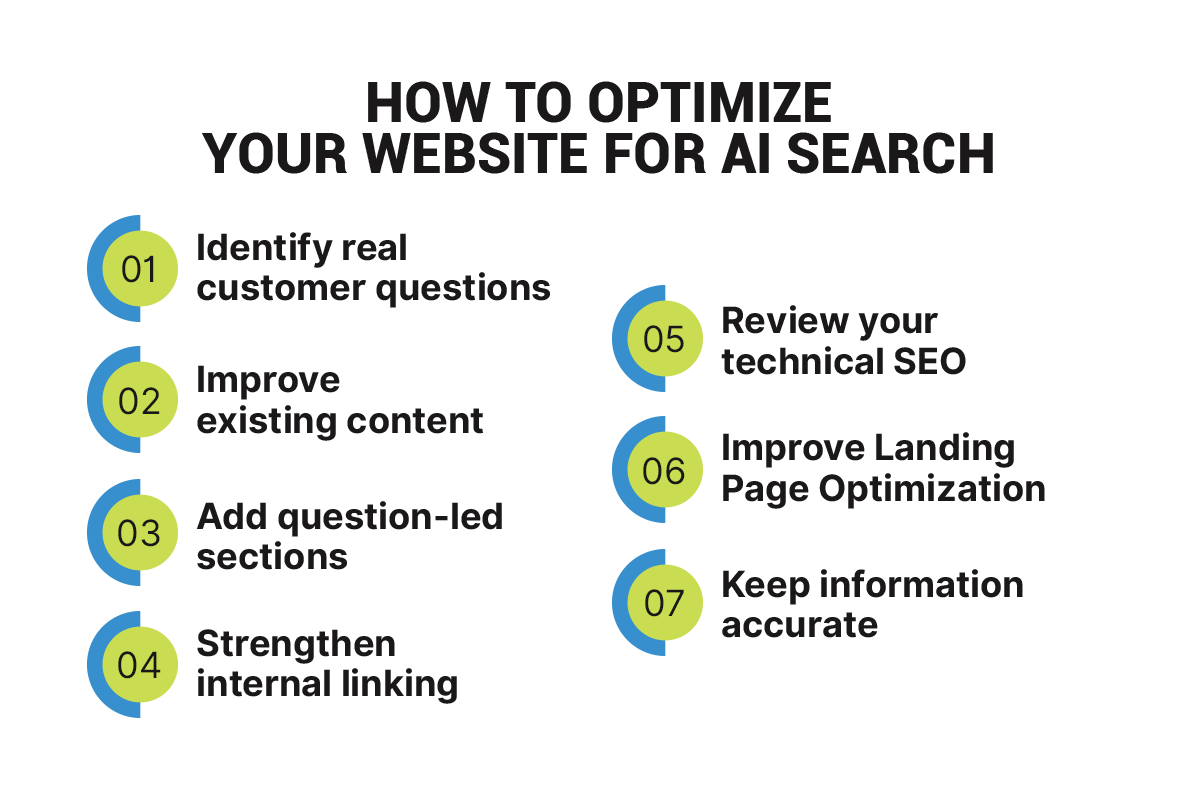
How to Optimize Your Website for AI Search
Start with the content and structure already present on your website. A practical process includes:
- Step 01
Identify real customer questions
Review sales conversations, FAQs, search queries and customer concerns.
- Step 02
Improve existing content
Look for pages with useful information that could be clearer, more complete or better organised.
- Step 03
Add question-led sections
Address important questions naturally within service pages and blogs.
- Step 04
Strengthen internal linking
Connect related pages so users and search systems can understand the relationship between topics.
- Step 05
Review your technical SEO
A well-written page still needs a website that can be crawled and accessed effectively.
- Step 06
Improve landing page optimization
Make sure important service pages clearly explain the offer, audience, benefits, proof and next step. Our guide to landing page optimization covers this in depth.
- Step 07
Keep information accurate
Outdated claims can damage both user trust and the overall quality of your content.
§ 08
Common AEO and SEO Mistakes to Avoid
Businesses often make the mistake of treating AI search as another keyword-placement exercise. Avoid:
- Writing content solely for algorithms
- Stuffing questions into pages unnaturally
- Publishing vague answers without useful context
- Creating multiple pages covering the same topic
- Ignoring technical SEO
- Using outdated or unsupported information
- Making exaggerated claims
- Treating FAQs as a place to insert random keywords
The goal is to make content clear, useful, and trustworthy for people.
§ 09
Prepare Your Business for the Future of Search
Search is becoming more conversational, contextual, and answer-driven. That does not mean businesses need to choose between established SEO practices and emerging AI search strategies.
The stronger approach is to build a website that does both: easy to discover and genuinely useful once discovered.
That means creating content around real customer needs, answering questions clearly, building authority, and maintaining a technically strong website.
At DigiClicks, we combine SEO, content, website development, and digital strategy to help businesses build stronger online visibility as search continues to evolve. A future-ready search strategy starts with understanding how your customers search and making sure your business has something valuable to say when they do.
- AEO
- SEO
- AI search
- Content strategy